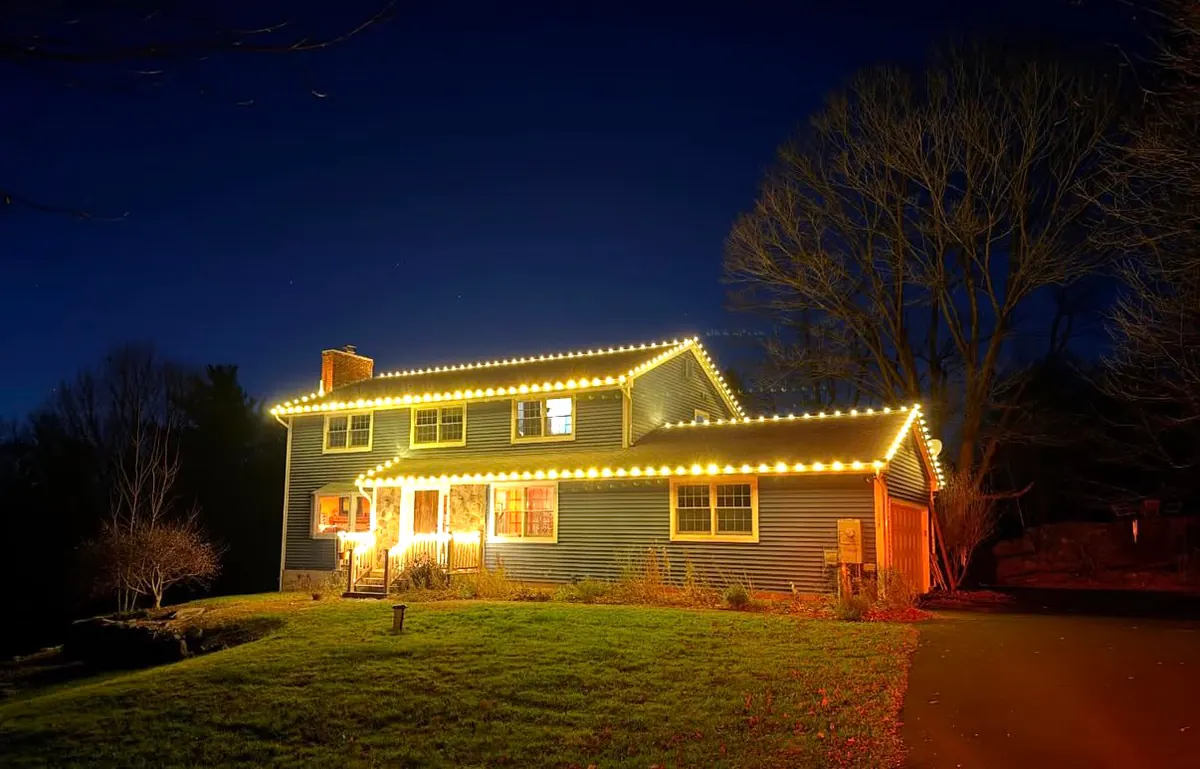
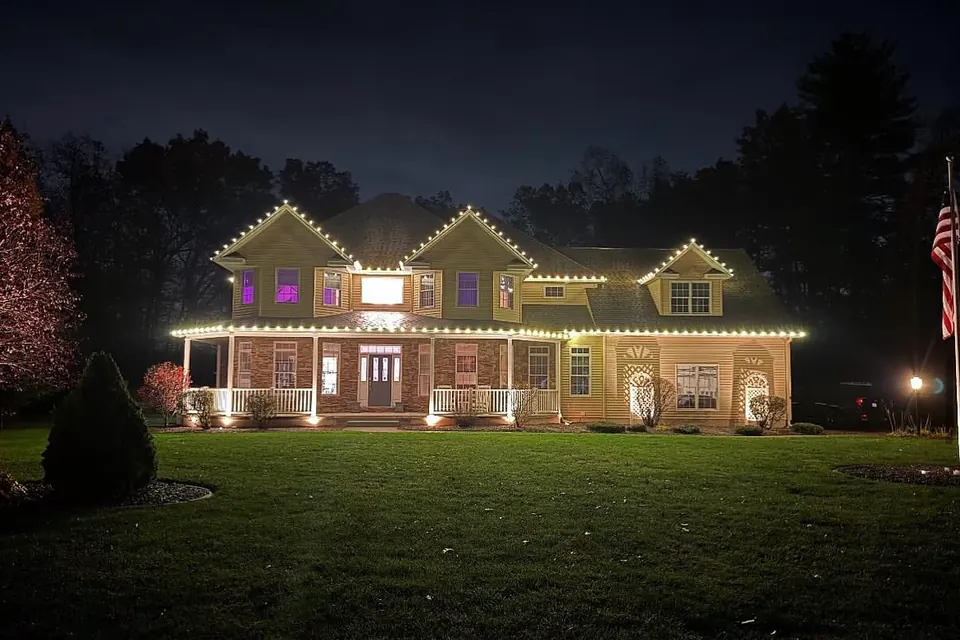
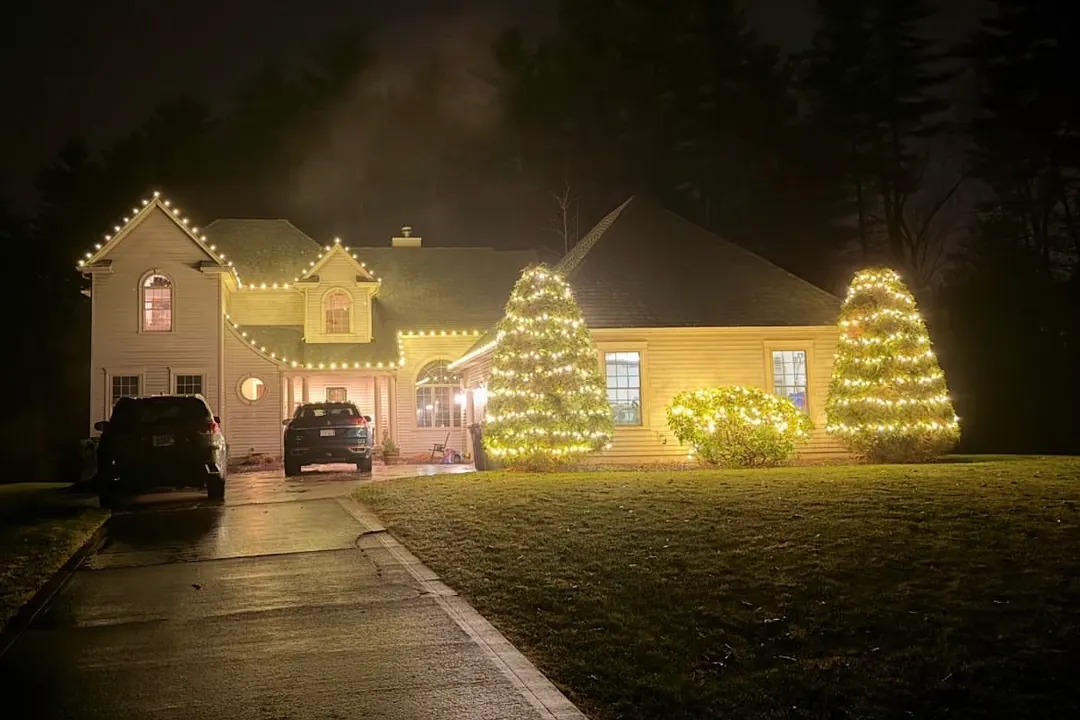
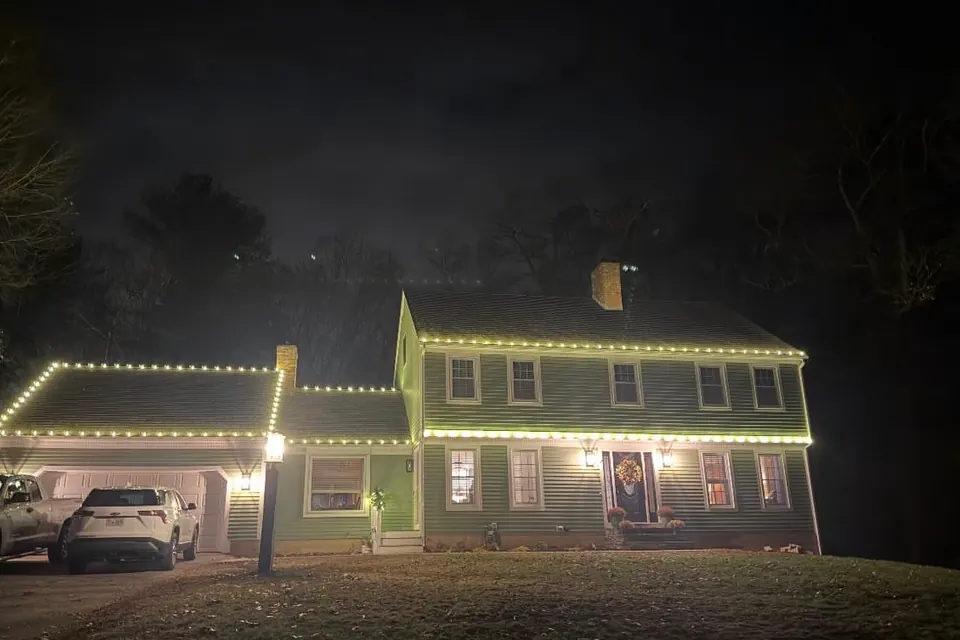
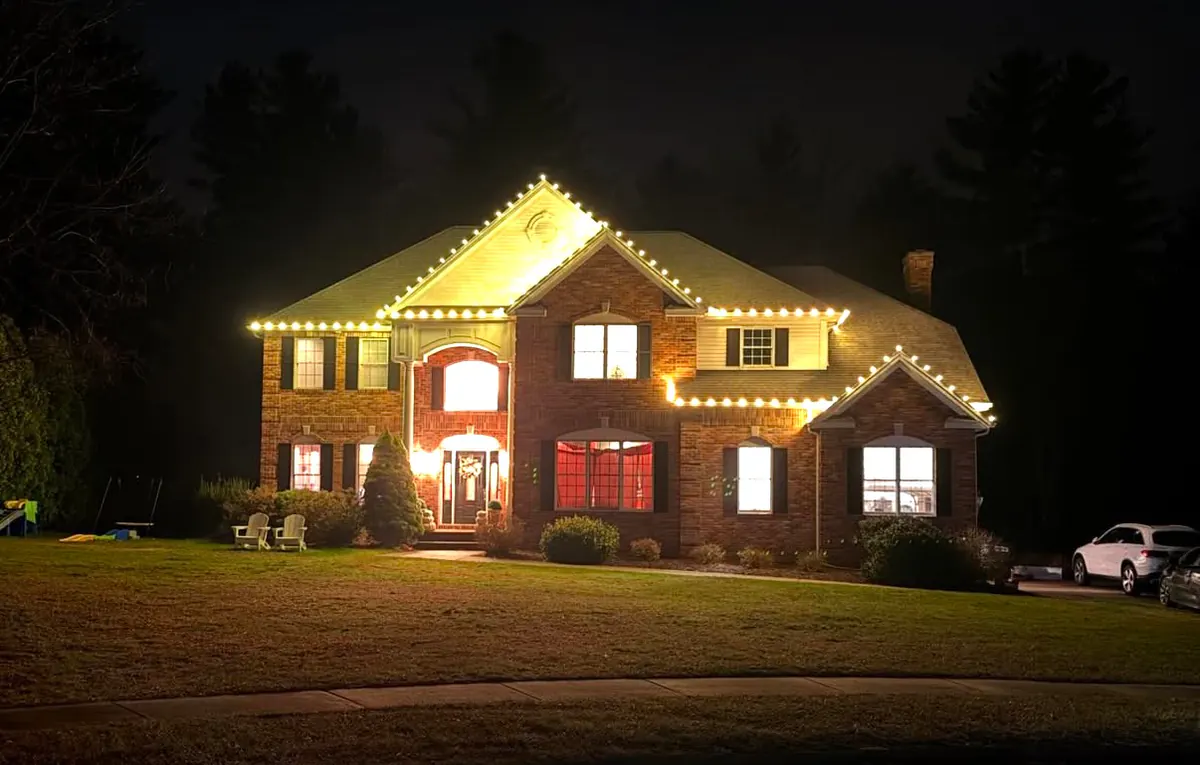
Christmas Light Installation Done From Our Ladders, Not Yours
The reason homeowners call is not decoration. It is the twenty feet between the driveway and the gutter. Christmas light installation is mostly that twenty feet, and it is the part we do. We work houses in Longmeadow, East Longmeadow, and Wilbraham every fall.
We measure the roofline before we quote, so the run is cut to your house, not to a box length
Bulbs go into the strands at the shop, which takes about an hour off the job at your address
Every strand hangs on a clip. Nothing gets stapled, nailed, or screwed into your trim
The whole run gets plugged in and tested while the ladders are still up
One quote covers the whole season, not just the day the ladders go up. A house in Southwick gets the same scope as a house in Agawam. Nothing on the list below is an add-on.
Roofline runsThe gutter edge, the sloped edges, and the dormer faces. The line the street sees.
Bushes and bedsWrapped by hand, one branch at a time, which takes longer and shows.
Wreaths and greeneryOver the garage, on the front door, along a porch railing.
Walkway and column accentsWhere a path needs edge light or a porch needs a vertical line.
Season-long serviceA dark bulb gets a visit, not a shrug.
Takedown and storageIncluded. You do not open a bin at either end of the season.
The roofline is what people read from the road, so the roofline run itself sets the shape of everything else.
Ladders sized to the house, instead of one ladder used for everything
Standoff stabilizers, so the rails never rest on a gutter
Someone on the ground the whole time anyone is up
Strands assembled in advance, so nobody climbs holding a coil
Four to oneA ladder is set at a four to one angle. Reaching a gutter twenty feet up puts the base five feet out.
Three feet aboveThe side rails have to stand at least three feet above the edge you are working from.
One hand onYou keep at least one hand on the ladder going up and coming down.
No loadYou do not carry a load that could make you lose your balance.
Inside a Professional Christmas Light Install
Most people have only ever hung a string from a big-box store. The product and the method here are both different. The difference shows up in February, not in December.
Bulbs Screwed In Before the Truck Arrives
The strands leave the shop already built. Every bulb is screwed in before anyone drives to your address. That one change takes about an hour off the job at your house. It also means nobody is standing on a ladder assembling anything.
Clips, Never Staples or Nails
Clips grip the gutter lip, the shingle edge, or the fascia. They come off in January and leave nothing behind. Staples and nails do not.
Gutter clips for a standard aluminum gutter run
Shingle clips where there is no gutter to grab
Ridge and peak clips for the top line
Nothing driven into wood, vinyl, or slate
Big Round Bulbs, Cut to Fit Your Roof
Our bulbs each screw in on their own. The whole run is cut to fit your roof. A store-bought string is one sealed piece, and when part of it dies you throw the whole thing out. That is the real difference, and almost nobody selling lights explains it.
Big round bulbs, spaced evenly, so the line reads clean from the road
Each bulb screws in on its own, so a dead one gets swapped instead of the whole string
The run is cut to your roof instead of coming in whatever length the box was
The line ends at your corner, not partway down a slope
Heavier Cord, Built to Sit Outside All Winter
The cord matters more than people think. Ours is heavier than the stuff on a store shelf. That heavier coat is what keeps a strand from going brittle in the cold or chalky in the sun. It sits outside from November into January and comes back fine.
Power Without a Cord Across the Walkway
The outlets decide the layout as much as the roof does. On a deep Longmeadow lot the run from the outlet to the far corner is long. Long runs have limits, and we plan around them.
Outdoor-rated cords only, run along the foundation, never across a step or a path
Loads stay inside the strand’s rated limit, and no run passes 250 bulbs or 250 feet
A timer, so the display comes on at dusk without anyone in the house doing anything
Ground fault protection on the circuit feeding the display
Two Stories, Dormers, and Where a Ladder Cannot Go
This is the honest part. Some parts of some houses do not get lit, and we say so at the quote. Steep slate, a third story with no safe footing, or a gutter over a stairwell landing changes the plan. Longmeadow holds both extremes. There are low bungalows with deep eaves near the center of town, and slate-roofed estates off Shaker Road.
Tested Before the Ladders Come Down
The run gets plugged in and walked from the street while the crew is still on site. A dark bulb found now costs five minutes. The same bulb found in December costs a return trip.
The Install Process, Step by Step
01
Call or send the form.
We take the address and the rough scope on the first call.
02
Walk the property.
We measure the roofline, find the outlets, and show you what we would light.
03
Approve the plan.
You confirm the coverage, and the install date goes on the calendar.
04
Build the strands.
Every bulb gets screwed in at the shop, so the truck arrives ready to hang.
05
Hang and test.
We work the roofline, then the ground, then plug in the whole display before we leave.
Longmeadow, East Longmeadow, Hampden, Wilbraham, Agawam, Feeding Hills, Southwick, Westfield, and Hampden County, Massachusetts. Suffield, West Suffield, and Granby, Connecticut, in Hartford County.
We Bring the Ladders. You Stay on the Ground.
The calendar fills from October forward. Every week after that, the roof gets harder to work.